
The Science Behind MicroGenDX DNA Diagnostics
MicroGenDX uses a technology called Next-Generation DNA Sequencing (NGS) to deliver the cutting-edge results you expect.
Over the last decade, we’ve spent countless hours refining our processes to deliver the fastest, most accurate, and most actionable results to patients and their providers. Over the years we’ve stood by our commitment to continuous improvement, seeking to set a new standard for medical diagnostics.
Our goal is to deliver the most accurate and effective results possible, for any infection you or your provider may encounter. That’s why we accept over a dozen different sample types and continuously look for opportunities to improve. Each step of our process is finely tuned by our expert team of scientists and laboratory technicians to optimize outcomes. From the time we receive your sample to the time we provide results, we can assure you that the greatest care possible is provided.
Once we receive your sample, we start by extracting the genetic material with specialized techniques. This removes any host (Human) DNA, leaving the DNA of microorganisms that may be causing your infection. Every specimen we receive undergoes rigorous quality control before we begin the sequencing process. NGS samples at MicroGenDX are processed on the state-of-the-art Illumina MiSeq i100 Plus platform, the newest generation model available from Illumina. Once samples are ready for sequencing, they are processed on the i100 to deliver the fastest and most accurate, specific, and sensitive results possible. In most cases, results are delivered inside of 24hours of sample receipt, an industry-shattering benchmark for turnaround time. Positive and negative controls run alongside each specimen throughout the sequencing process, guaranteeing the best possible results.
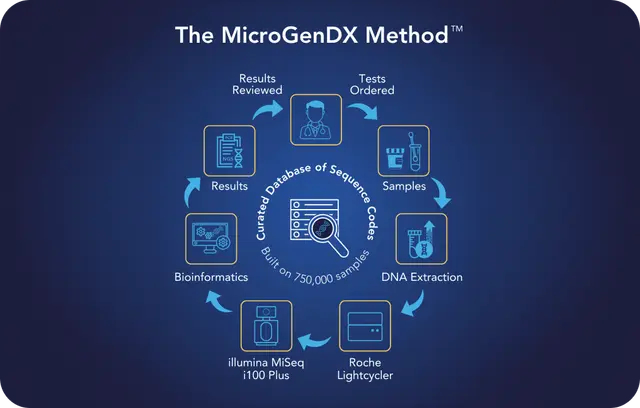
With over a million samples processed to date, MicroGenDX has the most comprehensive database available. Through our advanced techniques and the dedication of our expert scientists, our database has grown to include over 60,000 species of bacteria and Fungi. As we receive samples, our database continues to grow and is carefully curated by a dedicated team. Over the last 13 years, it has been the backbone of our NGS testing, a testament to the quality and reliability we strive for. Our sophisticated bioinformatics pipeline eliminates errors and provides confident taxonomic assignments, ensuring accurate results. No other microbial database in the world can compare to the size and quality of the one we maintain. If you want the best NGS testing available, the choice is obvious.
Advanced testing from MicroGenDX offers higher sensitivity, better accuracy, and quicker turnaround times than any alternative. It’s the ideal tool for rapid diagnosis of high-risk or chronic infections, combatting infectious disease, identifying treatment resistant pathogens, and reducing treatment duration. The next time you’re combating an infection, don’t wait around for inaccurate tests; break the cycle with MicroGenDX.
MicroGenDX qPCR + NGS & Antimicrobial Stewardship
You might have come across stories about “superbugs”, or antibiotic resistant bacteria that have developed Antimicrobial Resistance (AMR) and become drug resistant, a consequence of the overuse and improper use of antibiotics plaguing our society. MicroGenDX addresses this issue by employing state-of-the-art technology to provide your doctor with accurate answers necessary for diagnosis and effective treatment of your infection. Utilizing Next-Generation DNA Sequencing(NGS), MicroGenDX demonstrates superior sensitivity compared to traditional culture methods. This sensitivity serves as an invaluable tool for diagnosing high-risk infections, helping to minimize the risks of antimicrobial resistance associated with empirical treatment. Robust clinical evidence supports the effectiveness of NGS in diagnosing and treating complex and deep-seated infections, empowering healthcare providers to shorten treatment durations and avoid unnecessary, repetitive courses of multiple antimicrobials.
A study by the NYC Department of Health revealed 30% of E. coli UTIs resistant to Bactrim (themost commonly used antibiotic for UTI), emphasizing the importance of precise diagnostics.
Proper report interpretation is critical in utilizing NGS for to combat antibiotic stewardship. Not allbacteria are harmful to the host. Many are even important in creating a healthy body, such as lactobacilli in the vaginal tract. MicroGenDX helps fight antimicrobial resistance because it gives healthcare providers the full scope of bacteria and fungi in an infection and allows them to choose which specific microbes they want to treat, rather than threatening broadly. Only problematic (i.e. pathogenic or potentially pathogenic) species should be treated with proper antibiotic prescribing.
Biofilms
Your infection can be caused by more than one bacteria or fungi. These organisms often form communities called biofilms. Bacterial Biofilms, though unseen, play a significant role in chronic and sometimes antibiotic resistant infections, making them more challenging to diagnose and treat. At MicroGenDX, our advanced NGS sequencing process can unravel the complexities of biofilm infections, providing crucial insights for effective treatment.
What Are Biofilms?
Biofilms are communities of microorganisms that adhere to surfaces and each other, forming a protective layer called extracellular matrix (EPS). This matrix, consisting of polysaccharides, proteins, and glycoproteins, creates a stronghold for bacteria and fungi. This makes them harder totreat, even with antibiotics.
Imagine biofilms as bustling cities constructed by bacteria. Just like a city, biofilms consist of intricate structures built layer upon layer, housing various microbial communities. These bacteria form tight-knit communities, much like residents in a neighborhood, collaborating and communicating with each other to thrive. The matrix surrounding these bacteria acts like the infrastructure of the city, providing support, protection, and resources for its inhabitants. Just as cities can be resilient and difficult to penetrate, biofilms can be tough and resistant to antibiotics and immune responses, making them challenging to eradicate.
Biofilm Formation Process:
- Planktonic State: Microorganisms exist freely in a planktonic state.
- Initiation of Attachment: Microbes initiate attachment to each other within seconds.
- Building a Protective Community: Within 24 hours, microbes build a protective community with an EPS, strengthening antimicrobial resistance through horizontal gene transfer.
- Biofilm Maturation: Within 72 hours, the biofilm matures, with different oxygen levels and nutrient limitations, inducing slow-growth or no-growth states.
- Continual Detachment: Bacteria continually detach, establishing other biofilm colonies, and retaining antimicrobial resistance.
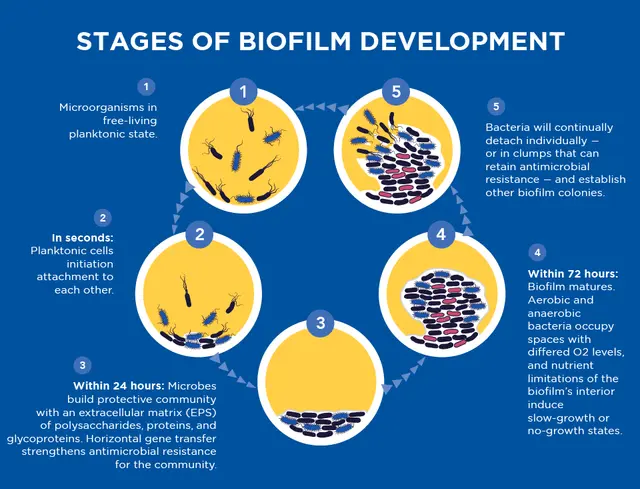
Traditional culture methods struggle to detect bacterial infections and biofilm bacteria adequately. Biofilms have multiple zones, making culturing them challenging. Bacteria within biofilms activate numerous genes, altering the cell envelope and molecular targets. Additionally, many bacteria in biofilms are known to activate genes that increase resistance to antimicrobial agents. Understanding these changes prior to attempting to treat is crucial for effective treatment and furthering the fight against Superbugs.
How Next-Gen DNA Sequencing (NGS) Helps
MicroGenDX’s next generation sequencing technology can identify the multiple bacteria and fungi within biofilms, offering a critical starting point in understanding their involvement in infections. This groundbreaking advancement surpasses all the limitations of traditional culture methods, cementing NGS as the diagnostic tool of the future. As bacteria continue to evolve to combat our antibiotics, we too need to evolve the ways we identify and treat infections.